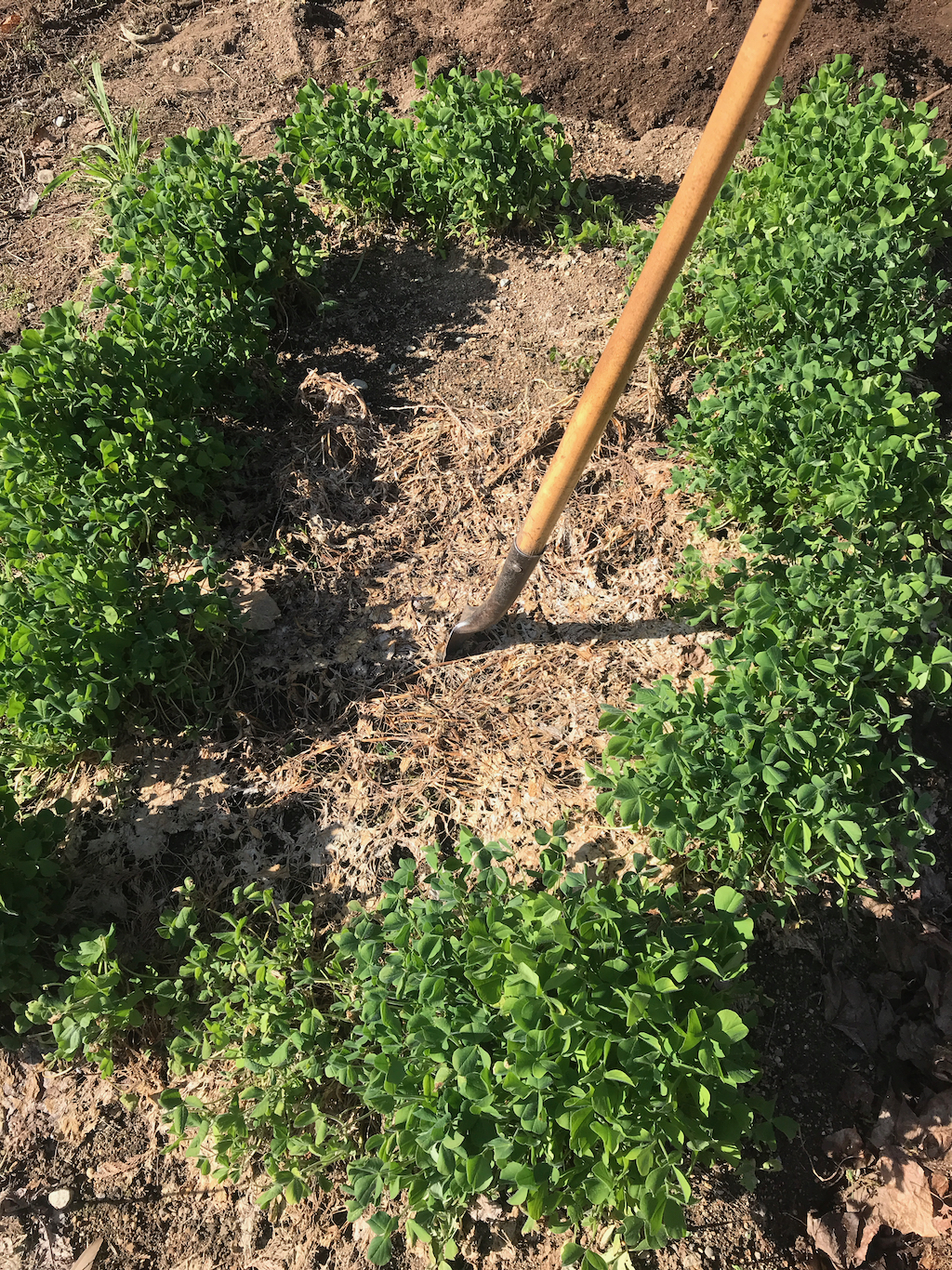
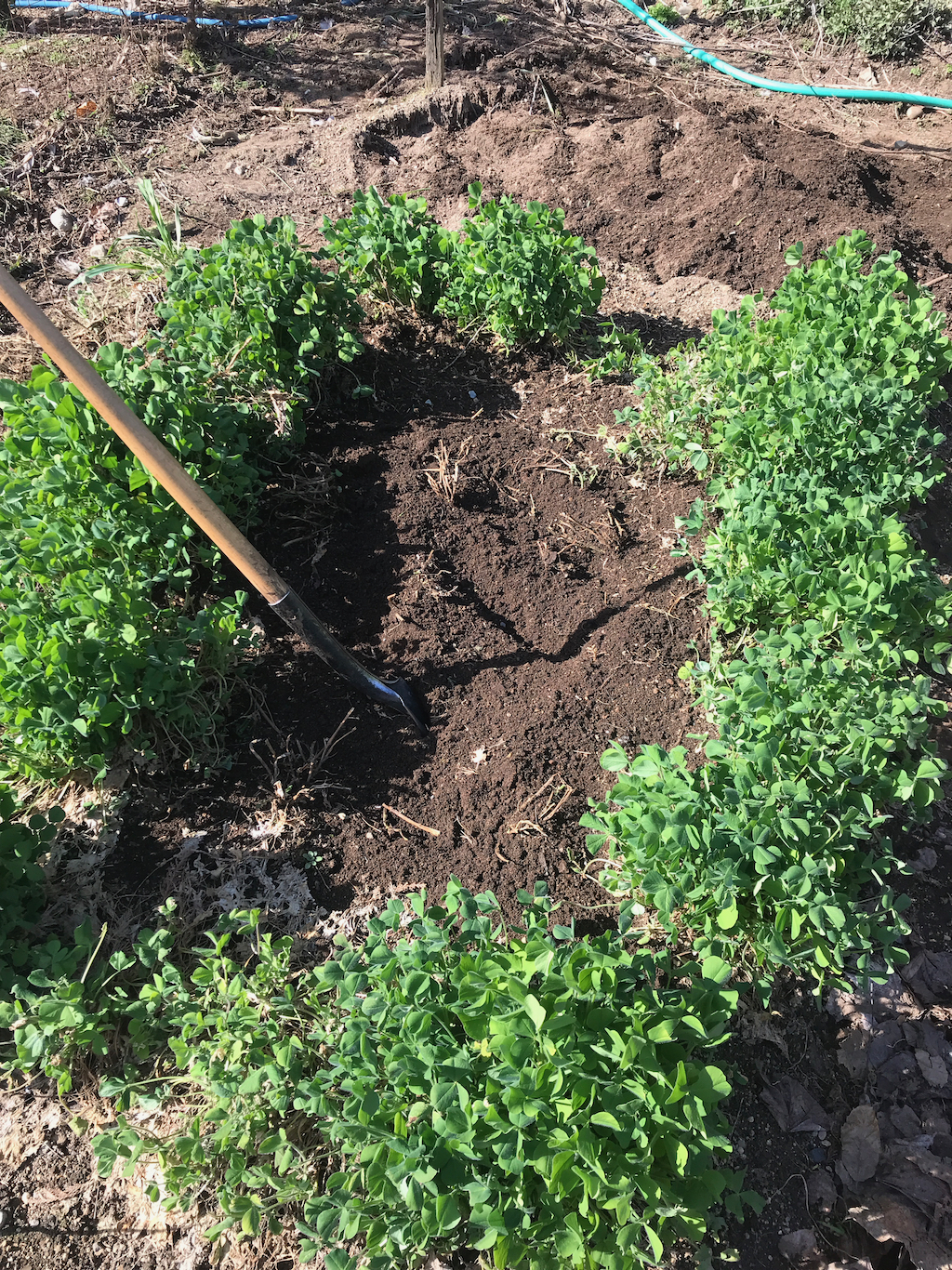
Spring is time to unleaf garlic’s winter mulch. Green shoots are up. The hand width narrow fishtail easily does the job lifting and tossing mulch aside. Getting into spaces hand size. Fine cleanup grasping with a gloved left hand and right hand holding the spade – like salad claws.
Garlic with winter mulchGarlic without winter mulch
Fishtail spade lifting and tossing winter mulch covering garlic. For fine cleanup, the spade in right hand and gloved left hand act like salad claws.
Push becomes pull. Pull becomes push. Over and over, again and again as masses interact. Push and pull are fundamental forces. Did I know the difference? Is there a difference?
Usain Bolt1 as the fastest human at 100 meters in 9.58 seconds shows us the difference in his gaits. Out of the blocks he drives forward with a pushing gait accelerating him to maximum velocity. At 30 meters he switches to the swing/backswing gait model2 . Maintaining his velocity by getting tall, straight, knees up, shoulders down, and dominates the race. Watch the video below.
His leading forefoot centre touches down in front of the centre of mass (COM) followed with hamstring activation pulling COM forward. As COM crosses centre of pressure (COP) the hamstring pull becomes a quadriceps push taking off and launching his body into flight to the next touch down. Every foot touch propels his mass forward with minimal braking.
Walking can use a similar gait. The leading foot pulls the COM forward with hamstring activation. As COM crosses over the COP the quads activate pushing the COM forward. Learn this gait takes time and you can practice with every step you take.
Start with one leg at a time. Use shorter steps at the begin. Vary the gait with asymmetrical movements. Progress to longer steps and controlled symmetrical movement. Set a goal of Bolt-like grace while walking, your mass slides / flows forward above the Earth’s surface.
Footnotes
Krzysztof M, Mero A. A kinematics analysis of three best 100 m performances ever. J Hum Kinet. 2013 Mar 28;36:149-60. doi: 10.2478/hukin-2013-0015. PMID: 23717364; PMCID: PMC3661886↩︎
Mattes K, Wolff S, Alizadeh S. Kinematic Stride Characteristics of Maximal Sprint Running of Elite Sprinters – Verification of the “Swing-Pull Technique”. J Hum Kinet. 2021 Jan 30;77:15-24. doi: 10.2478/hukin-2021-0008. PMID: 34168688; PMCID: PMC8008308. ↩︎
I missed the tai chi class about shifting body weight. I continued to miss this class for over 30 years until encountering Master Stephen Hwa’s teaching. “The most important step is when you are stepping forward the body weight does not go with the foot until the foot is on the ground and then bring the body weight forward… engaging our core muscle … to pull on the leading foot so you are pulling yourself forward ….” Master Hwa explaining pull forward movement
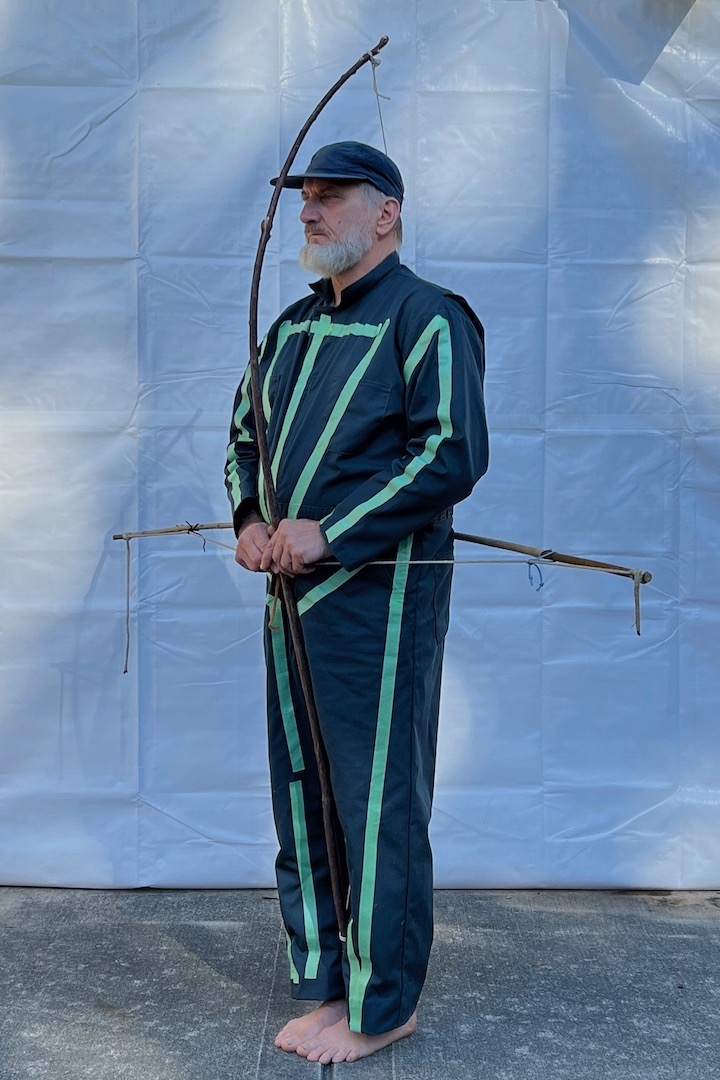
I can choose to pull or push. Shifting to a pull forward movement model remedied years of nagging leg sciatic nerve pain. Pain that would ebb and flow and yet got worse over time despite increasing tai chi practice. I thought it impossible that my tai chi was the root of the nerve pain. In hindsight, tai chi was not the problem, it was me pushing my body mass and jamming muscles, tendons, ligaments together cause nerve irritation. Pulling opens the tissue much as pulling opens the space between a bow’s stave and string. It is useful to think of the human as a single strut bow tensegrity structure.
Missing class summary:
A body is everything inside its form and has mass. A force is the agent changing movement between the bodies. Force can be external or internal. Force has direction and magnitude. Force can be push or pull. Force applied behind the body is Push. Force applied in front of the body is Pull. Gravity is a pull force from Earth’s mass and pulls my centre of mass to it’s centre. Applied force requires contact with Earth’ s surface to move my body’s mass from here to there . Proprioception is our sense of body position, force, and movement and we feel the applied force as weight or pressure through feet and other contact points. Skeletal muscle contraction create the internal force applied through contact with Earth’s surface.
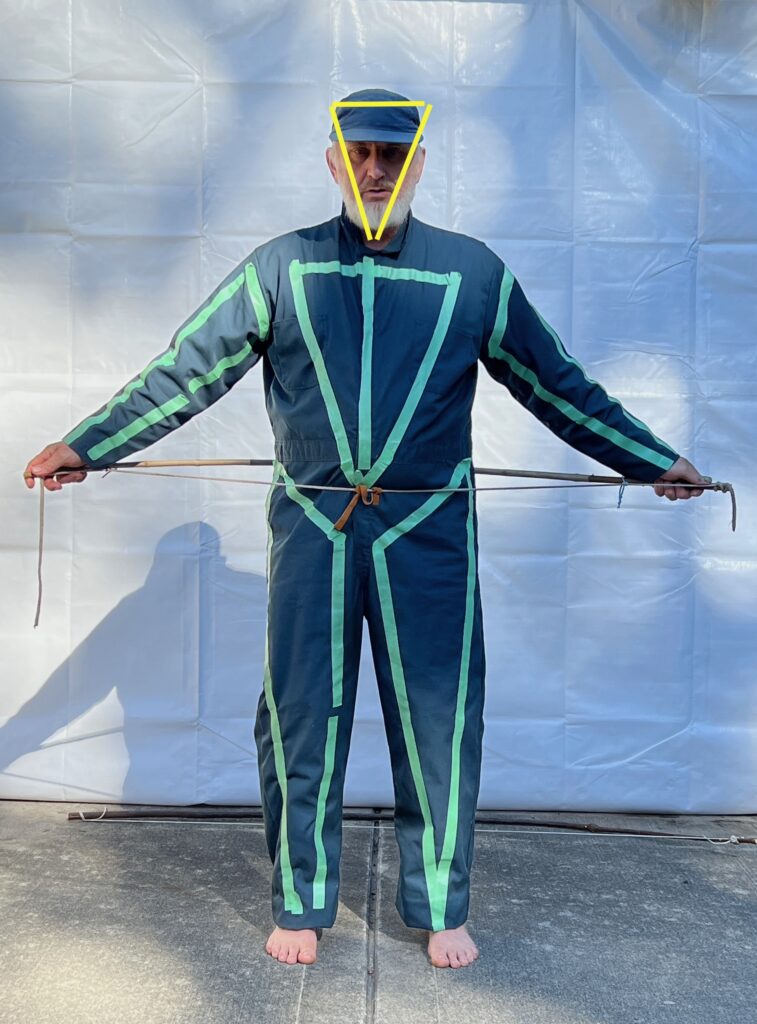
Body is divided into 7 multi-element segments: 1 head, 2 half torsos, 4 limbs. Stance is neutral 50/50 weight distribution. Centre of mass (COM) at torso lower apex. Bow divides upper from lower. Pelvis is the saddle connecting rider above and horse below. Muscle control acts on single whole body strut, bow and string, tensegrity model. Pull force applied to bow-string control, COM and weight shifting, in movement direction. Balance is COM inside the base of support which are the feet.
Foot acts as a gravity sucking pad. Pressure variation is highly dynamic for landings and releases. Suitable for horizontal earth climbing. Landing, releasing, repositioning, landing. Pulling the CoM towards the foot increasing anchoring result… ” ‘pushing’ pads away from the body results in an unstable contact, reflected in a rapid decrease in contact area and thus effortless detachment, whereas ‘pulling’ pads towards the body results in a stable or increasing contact area, and strong attachment.” http://dx.doi.org/10.1098/rstb.2019.0199
Drive front edge with right foot adding penetrating power, then a backface down pry, and final toss. Body stance is parallel to fishtail face. Use legs not shoulders for power.


Recent Comments